Acrylique ou verre pour les projets d'aquarium : Quel est le bon choix ?
Introduction
Les grands aquariums et les installations d'océanariums imposent des exigences particulières aux matériaux de construction. À mesure que la taille des bassins et la profondeur de l'eau augmentent, la pression exercée sur les vitres d'observation s'accroît continuellement, ce qui fait du choix des matériaux un élément essentiel de la conception technique globale, bien plus qu'une simple décision esthétique. Dans ces environnements, la vitre doit non seulement garantir une visibilité optimale sur le milieu aquatique, mais aussi assurer la stabilité structurelle à long terme sous une charge hydrostatique constante.
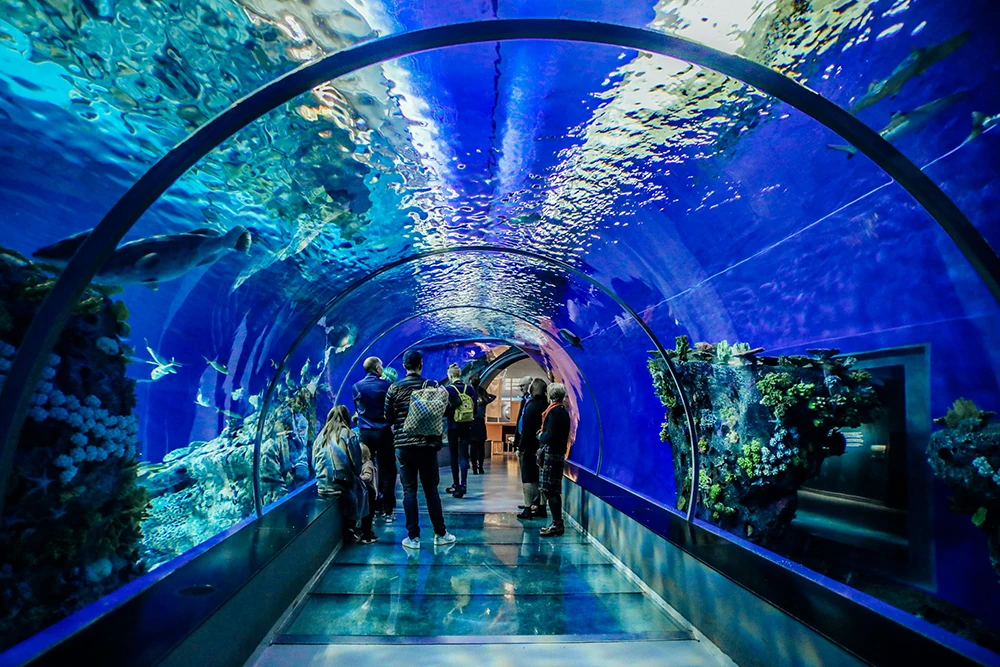
Pour la plupart des aquariums de petite et moyenne taille, le verre a toujours été un choix courant en raison de sa rigidité et de la dureté de sa surface. Cependant, à mesure que les projets prennent de l'ampleur pour s'étendre à de grands aquariums publics, des tunnels sous-marins et des installations architecturales aquatiques, les limites du verre deviennent plus évidentes en termes de poids, d'exigences d'épaisseur et de flexibilité de conception. C'est là que l'acrylique commence à être envisagé comme une alternative, et il devient essentiel de bien comprendre les différences entre ces deux matériaux avant de prendre une décision finale concernant la conception du système.
La différence de performances optiques entre l’acrylique et le verre devient plus évidente dans les applications d’aquariophilie à grande échelle, où la lumière doit traverser des matériaux transparents épais sur de longues distances. L’acrylique conserve généralement une transmission lumineuse d’environ 92% avec une distorsion des couleurs minimale, ce qui garantit une expérience visuelle plus stable et plus naturelle dans les grands panneaux et les structures sous-marines. Le verre standard transmet généralement entre 80 et 85 % de la lumière, et dans les sections plus épaisses, il peut présenter une légère teinte verte due à sa composition, ce qui rend la clarté visuelle moins homogène dans les grandes baies vitrées et les environnements de type tunnel.
Résistance aux chocs et sécurité
L'acrylique présente une résistance aux chocs nettement supérieure à celle du verre. Avec des valeurs sans entaille dépassant souvent 20 kJ/m² (norme ASTM D256), il absorbe plus efficacement les contraintes localisées et les chocs soudains. Cela réduit le risque de fissuration soudaine dans des environnements exigeants tels que les aquariums publics ou les océanariums, où les panneaux sont exposés à une pression continue et à des interactions liées à leur exploitation. À l’inverse, le verre est plus rigide mais aussi plus cassant, et en cas de rupture, il a tendance à se briser en fragments tranchants, tandis que l’acrylique se brise généralement de manière plus contrôlée et moins dangereuse, ce qui constitue un facteur important dans la conception axée sur la sécurité publique.
Poids et charge structurelle
L'acrylique est environ 50% plus léger que le verre à épaisseur égale, ce qui a une influence directe sur la conception structurelle et la complexité de la mise en œuvre dans les grands aquariums. Ce poids réduit allège la charge pesant sur les structures porteuses et simplifie la manipulation pendant la construction, en particulier dans le cas de panneaux surdimensionnés ou courbes, où le verre devient de plus en plus difficile à installer à mesure que les dimensions augmentent. Cet avantage en termes de poids est l’une des principales raisons pour lesquelles l’acrylique est largement utilisé dans les projets d’aquariums à grande échelle et de jeux d’eau architecturaux.
Durabilité à long terme dans l'eau
L'acrylique de qualité aquarium présente une très faible absorption d'eau, généralement inférieure à 0,1%, ce qui garantit des performances stables lors d'une immersion à long terme. Il est également chimiquement stable lorsqu'il est exposé en permanence à l'eau et ne libère pas de substances susceptibles d'altérer la qualité de l'eau. Comparés au verre, ces deux matériaux offrent de bonnes performances dans l’eau, mais l’acrylique est plus couramment utilisé dans les grands aquariums où la stabilité à long terme du matériau est essentielle. Cette stabilité est indispensable pour les installations conçues pour fonctionner en continu pendant de nombreuses années sans dégradation.
Qu'est-ce qu'une plaque d'acrylique pour aquarium ?
Tous les acryliques ne conviennent pas à une utilisation en aquariophilie. L'acrylique standard disponible dans le commerce ne présente pas la cohérence structurelle ni la pureté optique requises pour les grandes installations contenant de l'eau, où les panneaux doivent fonctionner de manière fiable sous une charge hydrostatique continue pendant des années sans se détériorer.
Plaque d'acrylique pour aquarium Il s'agit d'un matériau spécialement conçu à cet effet — fabriqué à partir de monomères MMA de haute pureté via un procédé de coulée en continu, puis soumis à un recuit contrôlé afin d'éliminer les contraintes internes résiduelles susceptibles de provoquer des craquelures ou une défaillance prématurée sous une pression prolongée. Il en résulte une plaque acrylique pour aquarium capable d’atteindre une transmittance lumineuse de 92% avec une distorsion optique inférieure à 0,1%, une résistance à la compression ≥ 80 MPa et une résistance aux chocs supérieure à 20 kJ/m² (ASTM D256). Disponible dans des épaisseurs allant jusqu’à 300 mm et des dimensions de panneaux allant jusqu’à 6 000 × 3 000 mm, elle est également traitée avec un revêtement de surface anti-algues afin de réduire l’encrassement biologique — un aspect opérationnel important pour les installations où la fréquence de nettoyage des bassins influe directement sur les coûts d’entretien.
Quelles dimensions et quelle épaisseur choisir ? Un guide pratique
Choisir le bon épaisseur de la feuille acrylique Pour les aquariums, cela dépend principalement du volume d'eau, des dimensions des panneaux et des exigences en matière de charge structurelle. À mesure que la taille de l'installation augmente, la pression hydrostatique s'accroît considérablement, ce qui fait du choix de l'épaisseur une décision technique cruciale.
Épaisseur
Taille maximale
Volume approprié
Application recommandée
10 à 20 mm
1220×2440mm
≤ 5 000 L
Aquariums domestiques
20 à 50 mm
2000×3000mm
5 000 à 20 000 L
Réservoirs d'exposition commerciaux
50 à 100 mm
3000×6000mm
20 000 à 100 000 L
Grands aquariums
100 à 300 mm
Sur mesure
>100 000 L
Tunnels d'océanarium
Aquariums domestiques (10 à 20 mm, ≤ 5 000 L)
Pour les aquariums de récif sur mesure ou les grandes installations domestiques, une épaisseur de 10 à 20 mm offre une résistance suffisante tout en garantissant un poids raisonnable.
Cuves d'exposition à usage commercial (20–50 mm, 5 000–20 000 L)
Les halls d'hôtel, les aquariums de restaurant et les vitrines de magasins publics entrent dans cette catégorie. L'épaisseur de 20 à 50 mm garantit sécurité et perfection optique.
Grands aquariums publics (50 à 100 mm, 20 000 à 100 000 L)
Les installations phares, telles que les bassins à requins ou les grands aquariums représentant des récifs coralliens, nécessitent de l'acrylique d'une épaisseur comprise entre 50 et 100 mm pour résister à la pression hydrostatique sans déformation visible.
Tunnels d'océanarium (100 à 300 mm, >100 000 L)
Les tunnels de passage et les vitres d'observation en profondeur destinés aux habitats des baleines ou des dauphins nécessitent une épaisseur supérieure à 100 mm ; ils sont souvent fabriqués sur mesure selon des spécifications techniques.
Consignes de traitement et d'installation
Méthode de collage de feuilles
Utiliser une colle à base de monomère de méthacrylate de méthyle dans le cadre d'un procédé de moulage sous vide. Cela permet d'obtenir une planéité des joints ≤ 0,05 mm/m. La résistance finale de l'assemblage est ≥ 8 MPa (ASTM D3163), soit ≥ 90% de la résistance du matériau de base, ce qui garantit l'absence de risque de fuite.
Traitement des bords
Le polissage au diamant garantit une continuité optique sans distorsion de réfraction. Les bords rugueux ou non polis diffusent la lumière et affaiblissent les lignes de collage.
Processus de gestion du stress
Un processus de recuit par paliers est appliqué : 60 °C pendant 4 heures, puis 80 °C pendant 8 heures, puis à nouveau 60 °C pendant 4 heures. Cela permet d'éliminer les contraintes internes susceptibles d'entraîner l'apparition de fissures ou une rupture sous contrainte.
Étanchéité et pose
Utilisez des bagues d'étanchéité en caoutchouc EPDM et des brides de compression en acier inoxydable. Évitez les matériaux susceptibles de déformer l'acrylique ou de l'attaquer chimiquement.
Exigences en matière de maintenance
Utilisez exclusivement un nettoyant spécialement conçu pour l'acrylique. N'utilisez jamais de grattoirs rugueux ni de nettoyants à base d'ammoniaque, car ils risqueraient de rayer ou de fissurer la surface.
Questions fréquemment posées
Q1 : Dans quels cas faut-il privilégier le verre à l'acrylique pour la réalisation d'aquariums ?
Le verre convient aux aquariums de petite à moyenne taille, où les dimensions des panneaux et la pression de l'eau sont limitées. Il offre de bonnes performances dans les structures rigides et planes, mais s'avère moins pratique pour les grands bassins ou les conceptions courbes en raison de son poids, de sa fragilité et des contraintes liées à son épaisseur. Pour les projets d'aquariums plus grands ou plus complexes, l'acrylique est généralement privilégié pour sa plus grande souplesse structurelle et sa meilleure résistance aux chocs.
Q2 : L'acrylique utilisé pour les aquariums est-il adapté à une exposition prolongée à l'eau de mer et à la faune marine ?
R : Oui. L'acrylique utilisé pour les aquariums présente une excellente stabilité chimique lorsqu'il est immergé dans l'eau pendant de longues périodes et ne libère aucune substance nocive dans l'eau. De plus, il présente un taux d'absorption d'eau extrêmement faible et conserve sa stabilité dimensionnelle lors d'une utilisation continue, ce qui le rend particulièrement adapté aux aquariums d'eau de mer et aux habitats pour la faune marine.
Q3 : Quels sont les critères à prendre en compte pour choisir un produit de haute qualité ? plaque d'acrylique pour aquarium?
Une grande qualité plaque d'acrylique pour aquarium Elle se caractérise généralement par une combinaison de transparence optique, de résistance mécanique et de stabilité à long terme en cas d'exposition à l'eau. Concrètement, cela inclut une transmittance lumineuse d’environ 92% (ASTM D1003) pour une visibilité optimale dans les panneaux épais, une résistance à la compression ≥ 80 MPa et une résistance à la flexion ≥ 100 MPa pour résister à la pression hydrostatique dans les grandes installations, ainsi qu’une résistance aux chocs supérieure à 20 kJ/m² (ASTM D256) pour une sécurité accrue dans les lieux publics. Ensemble, ces propriétés permettent de déterminer si le matériau est adapté aux applications exigeantes en aquariophilie, telles que les grands bassins et les structures sous-marines.
Conclusion
Le choix entre l'acrylique et le verre pour les projets d'aquariums dépend en fin de compte de l'échelle de l'installation, des contraintes de charge structurelle et des priorités opérationnelles à long terme. Le verre reste une option pratique pour les installations de petite taille et à budget réduit, où les dimensions des panneaux sont limitées et où la dureté de la surface est une priorité. Pour les aquariums publics de grande envergure, les tunnels d'océanariums et les installations aquatiques commerciales,La plaque acrylique pour aquarium offre une clarté optique exceptionnelle, une résistance aux chocs et des performances structurelles supérieures sous une charge hydrostatique continue, ce qui en fait le matériau de référence lorsque la fiabilité sur plusieurs décennies est primordiale.
En tant que fabricant de référence de plaques acryliques pour aquariums, fort de 17 ans d'expérience en usine, Jingruite propose des panneaux en acrylique coulé de haute qualité, d'une épaisseur comprise entre 10 mm et 300 mm, ainsi que des services de transformation et d'assemblage sur mesure. Grâce à un contrôle qualité rigoureux, à une personnalisation flexible avec de faibles quantités minimales de commande et à des tarifs directs d'usine, Jingruite propose des solutions matérielles rentables aux concepteurs d'aquariums, aux ingénieurs en structure et aux entrepreneurs du monde entier.
Brève introduction Le panneau acrylique est largement utilisé dans tous les domaines de la vie en raison de son excellente transparence, de sa légèreté et de sa facilité d'usinage. Cependant, ils diffèrent considérablement...
Si vous travaillez dans le domaine du durcissement par UV, du diagnostic médical, de la recherche optique ou de la conception d'équipements de bronzage, vous vous êtes sans doute déjà posé la question suivante : quel matériau permet de transmettre de manière fiable les rayons UV sans...
Lors de la réalisation de badges nominatifs gravés, d'enseignes de bureau ou d'étiquettes d'équipement, la question qui se pose est la suivante : quel matériau permet d'obtenir un contraste net et professionnel sans avoir à recourir à une peinture supplémentaire ? La feuille bicolore est...
Introduction Des bâtiments commerciaux aux installations industrielles, lorsqu'il s'agit de choisir des matériaux transparents pour des applications critiques en matière de sécurité, deux choix s'imposent : l'acrylique résistant aux chocs et le polycarbonate. Pour les professionnels du...