What Should You Consider Before Choosing a Double Color Sheet?
Start with the finished part, then work backward to the sheet specification.
Define the Finished Part and Its Use
Different finished parts need different sheet specifications.
A small adhesive-backed label should stay light and easy to handle. A large wall sign needs more rigidity. Control panels may also require holes, cutouts, and enough strength to withstand repeated handling.
Consider these common applications:
Small engraved labels: Focus on clear engraving and easy handling.
Flat wall signs: Choose enough thickness to stay flat after mounting.
Large panels: Consider the unsupported area and mounting points.
Control panels: Check rigidity, cutouts, mounting holes, and visibility.
A fully supported part may not need a thick sheet. Large unsupported panels usually require more rigidity.
Select Thickness for the Finished Part
Thickness affects rigidity, weight, and fabrication.
One thickness does not suit every finished part. A small label and a large wall panel can require very different thicknesses, even when both use the same material.
Finished Part
Thickness Consideration
Small label
A thinner sheet may be sufficient
Small flat sign
Choose enough thickness to stay flat
Large wall sign
Consider a thicker sheet when flexing is a concern
Control panel
Match thickness to size and mounting
Bent component
Confirm thickness with the forming process
A large unsupported panel places more emphasis on rigidity. A small label with full surface support may work well with a thinner sheet.
Thickness should also be confirmed against the planned fabrication method, especially when the finished part includes bending, holes, cutouts, or other processed features.
How Do Color, Finish, and Processing Affect the Final Result?
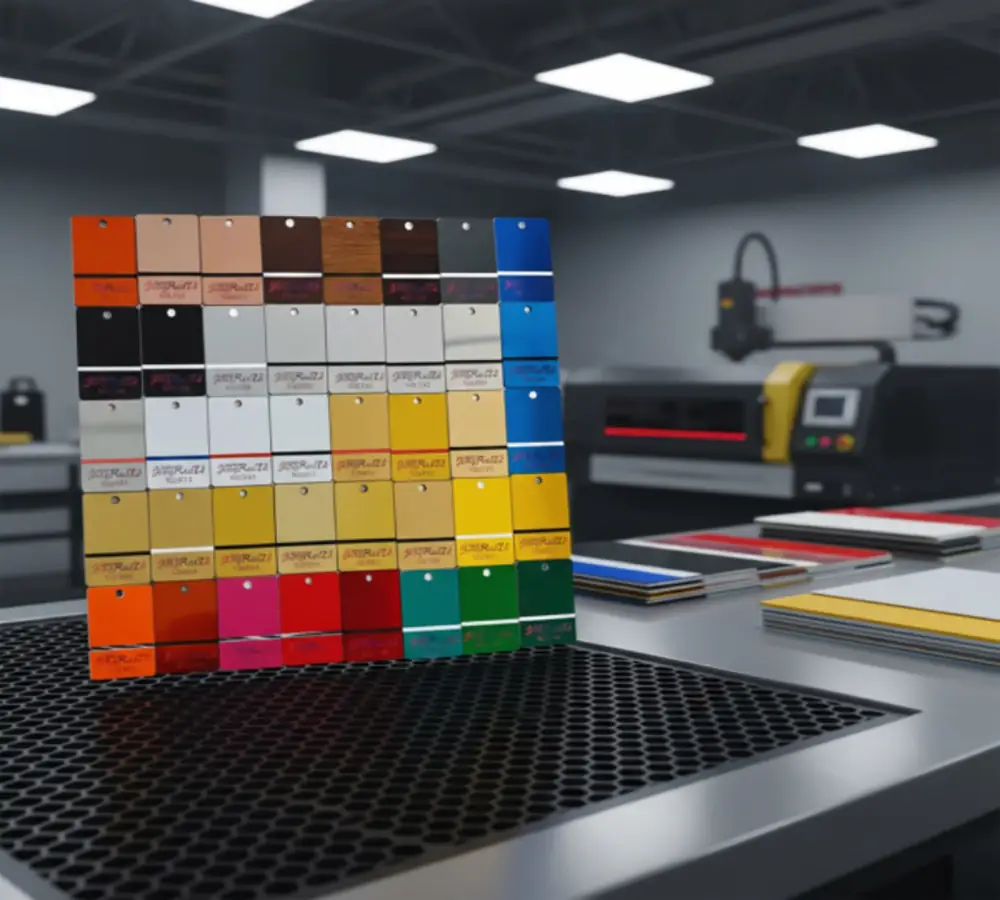
After thickness, the next decisions are color contrast, surface finish, and processing. Each one affects how the finished part looks and how easily engraved information can be read.
Choose a Color Combination for Clear Contrast
Two colors should create enough contrast to separate the engraved information from the surface.
Small text and symbols need particular attention. Strong contrast makes engraved information easier to identify.
Decorative signs may place more emphasis on the overall color design. Brand-related parts need colors that match the required visual identity.
Very small text should be tested before bulk production. A sample engraving can show whether the letters remain clear at the actual size.
Select the Surface Finish for the Application
Surface finish changes both the appearance and viewing experience of the finished part.
Glossy: Gives a smooth and reflective appearance.
Matte: Helps reduce surface reflection.
Textured: Creates a more distinctive surface effect.
Matte surfaces can be useful when glare makes engraved information harder to read.
Match the Processing Method to the Design
Text and logos need engraving. Outer shapes and openings require cutting. Routed features may need CNC machining, while formed parts may require hot bending.
An equipment identification plate, for example, may include a serial number and four mounting holes. Engraving can add the serial number, while cutting creates the outer shape and holes.
Double color sheets are commonly used for laser engraving because the engraved area can reveal a contrasting layer beneath the surface. When acrylic is selected as the material, acrylic for laser cutting can be considered for designs that include outlines, holes, slots, or internal cutouts.
Similarly, acrylic for engraving requires attention to the smallest text and graphic details. Small characters, fine lines, and narrow gaps can affect readability, so a sample engraving is useful before bulk production.
The sample should confirm that letters remain readable and that engraved areas create enough contrast.
This check is especially useful for detailed identification plates and small labels.
What Should Buyers Confirm Before Ordering?
Before placing an order, confirm the sheet specification and whether the project requires full sheets or finished parts.
Confirm the Complete Product Specification
A complete order should define the material, dimensions, thickness, color combination, finish, processing, quantity, and packaging.
For a signage project, the sheet may be supplied as a full sheet or as a finished component, so this requirement should be stated clearly. When acrylic is selected, an acrylic sheet for signage can also be specified according to the required application.
Complete specifications give the supplier enough information to prepare an accurate quotation and produce the required item.
Request a Sample Before Bulk Production
A sample can reveal problems before production starts.
Check the color contrast, surface finish, engraving clarity, cut edges, dimensions, and installation fit.
Once approved, the sample can serve as the production reference. This is more reliable than descriptions such as “dark blue” or “high contrast.”
Why Choose Jingruite for Double Color Sheet?
Once the sheet specification is confirmed, supply and processing options become the next consideration. Jingruite supports both standard sheets and customized solutions for different project requirements.
Option
Available Choices
Material
ABS / HDPE / Acrylic
Standard Size
600 × 1200 mm / 1220 × 2440 mm
Thickness
0.5–30 mm
Color
Standard and custom combinations
Finish
Glossy / Matte / Textured
Processing
Cutting / Laser engraving / CNC machining / Logo printing / Hot bending
Flexible Specifications for Different Projects
Jingruite can adjust the sheet specification when standard options do not match the finished part.
ABS is a common material option for double color sheets used for engraved labels, signs, identification plates, and control panels. HDPE and acrylic are also available when the project requires different material characteristics or processing options.
Custom sizes and thicknesses can be requested to match the finished design.
Custom Color Combinations
Jingruite offers both standard and custom color combinations.
A suitable color combination can improve the contrast of engraved text or help the sheet match a specific brand color. Glossy, matte, and textured finishes are also available for different visual effects.
Signs and identification plates can be sampled to check color, surface finish, and engraving results together.
Multiple Processing Options
Jingruite can combine different fabrication processes when a project requires a finished component rather than a standard sheet.
A custom panel, for example, may include CNC-machined features, mounting holes, and engraved identification marks. A customer drawing can define the position and size of each feature before production.
Support From Sheet Supply to Finished Parts
Jingruite provides both standard sheets and customized finished parts.
Custom acrylic fabrication can be arranged when acrylic is selected for a project. The requirements can include the customer’s drawing, finished dimensions, color requirements, surface finish, processing details, and quantity.
For double color sheets made from ABS or other available materials, the same information can be used to define the required sheet specification and finished-part requirements.
Packaging options include PE film protection, wooden pallets, and carton boxes.
Frequently Asked Questions
Can Jingruite Supply Double Color Sheets for Laser Engraving?
Yes. Jingruite supplies double color sheets for applications such as laser engraving, identification plates, labels, and signage. Buyers can confirm the required material, color effect, sheet specification, and engraving details before production.
Can Jingruite Make Custom Double Color Sheet Sizes?
Yes. Jingruite supports custom sheet sizes and thicknesses when standard dimensions do not match the finished design. Buyers can provide the required dimensions or drawings for review before ordering.
Can Jingruite Produce Double Color Sheet Parts From Customer Drawings?
Yes. Jingruite can review customer drawings and finished-part requirements for customized production. Drawings can define dimensions, holes, cutouts, engraved areas, and other features that need to be included in the final part.
How Does Thickness Affect a Double Color Sheet?
Thickness affects rigidity, weight, and how easily the sheet can be processed or formed. A small label with full surface support may work with a thinner sheet, while a large unsupported panel may need more rigidity. Finished size and mounting method should be checked before selecting thickness.
Is ABS Available for Double Color Sheets?
Yes. ABS is a common material option for Jingruite’s double color sheets. The sheets can be supplied in different sizes, thicknesses, color combinations, and surface finishes according to the project requirements. HDPE and acrylic are also available as alternative material options.
What Makes a Double Color Sheet Suitable for Engraved Signs?
The two-color structure can create visible contrast between the engraved area and the surface layer. This makes text, numbers, symbols, and simple graphics easier to identify after engraving. Actual results depend on the color combination, character size, and engraving settings.
Conclusion
Choosing the right double color sheet starts with the finished part, required engraving effect, and fabrication requirements. Sheet specifications should match the final product’s size, mounting method, color contrast, surface finish, and processing details.
Jingruite supports standard and customized sheet requirements, including material, size, thickness, color combination, surface finish, and fabrication. ABS is a common material option, while HDPE and acrylic are also available according to project requirements.
Buyers can also request laser engraving, cutting, CNC machining, logo printing, or hot bending when a finished part is required.
For a more accurate quotation, provide the drawing, finished dimensions, color requirements, processing details, and quantity. This gives Jingruite the information needed to confirm the suitable specification and production method.
Introduction Acrylic sheets, prized for their optical clarity (92% light transmission) and versatility, are revolutionizing industries from aerospace to healthcare. With a global market expected...
Introduction Acrylic sheets, known for their exceptional transparency (92% light transmission) and durability, have become indispensable in industries ranging from architecture to healthcare. With a...
Introduction Polyvinyl Chloride (PVC) sheets are a staple in construction, healthcare, and electronics due to their durability, chemical resistance, and cost-effectiveness. With the global PVC...
In applications where safety, beauty and durability are essential, one material stands out: flame retardant acrylic sheet. For projects in buildings, public transportation or high-end...