How to Choose a Flame Retardant Acrylic Sheet for Lighting, Windows, and Signage
Key Takeaways
Check the required fire classification before comparing materials. A UL 94 rating does not replace building fire-safety approval.
Review light transmission and haze together when visual clarity or light output matters.
Select sheet thickness according to panel size, support spacing, impact exposure, and forming depth.
Ask for test reports that match the specified material, color, and thickness before placing an order.
Introduction
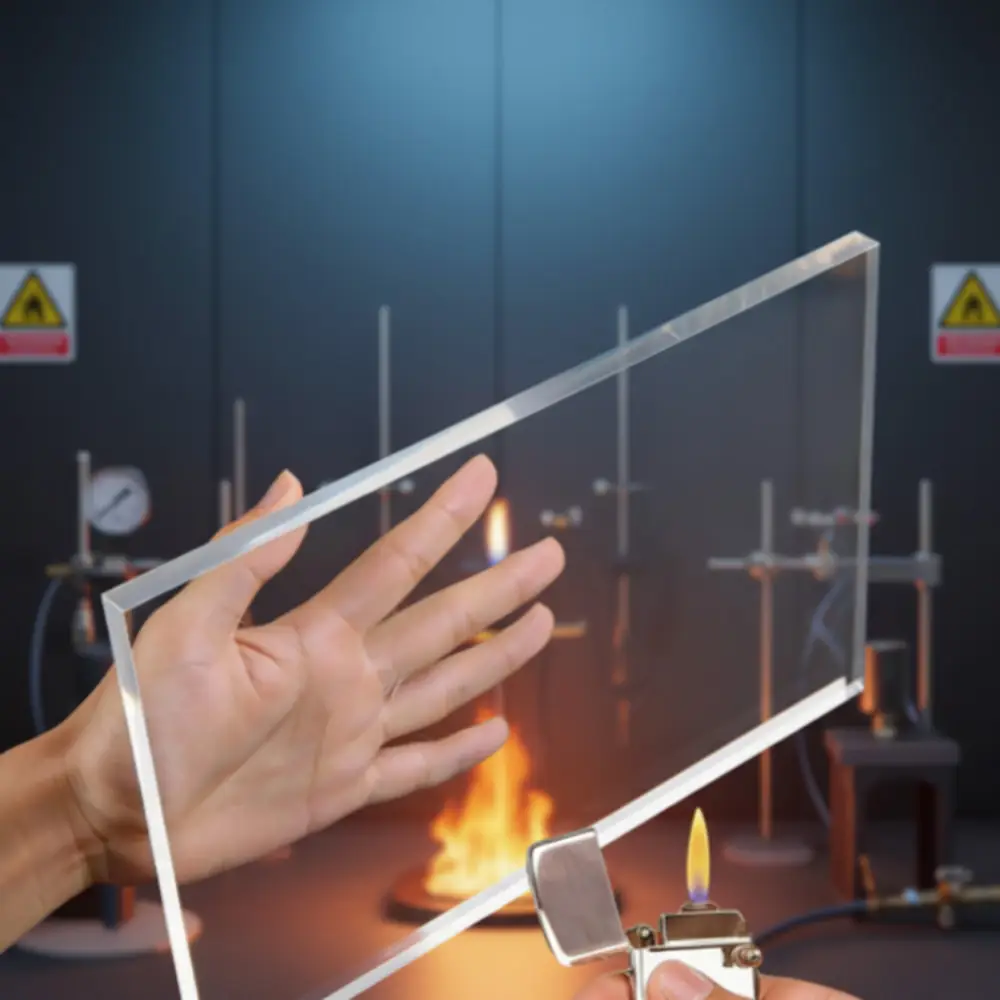
A flame retardant acrylic sheet can provide transparency, impact resistance, and improved flame behavior in applications where ordinary acrylic may not meet the required safety criteria. However, a fire classification alone does not establish whether a sheet is suitable for a lighting cover, viewing panel, or illuminated sign.
Buyers should assess three areas before choosing a material: verified fire performance, application-specific mechanical and optical requirements, and fabrication conditions. These checks help prevent problems such as selecting an unsuitable thickness, losing optical clarity during forming, or relying on a fire rating that does not cover the supplied specification.
What Should Buyers Check Before Selecting Flame-Retardant Acrylic?
The first step is to define what the finished part must do. A transparent panel used as a protective cover has different requirements from a backlit display or an interior partition.
How Does Flame-Retardant Acrylic Differ from Standard Acrylic?
Acrylic is valued for its transparency, surface finish, and ease of fabrication. Flame-retardant grades are formulated to improve how the material behaves when exposed to a flame. Depending on the formulation and test method, this may affect ignition, afterflame time, and flaming droplets.
Do not assume that every flame-retardant grade performs identically. Two sheets may have similar appearance but different test classifications, thickness coverage, or mechanical properties. Ask for the exact grade and supporting test documentation rather than relying on a general description such as “fire-resistant acrylic.”
Which Material Properties Affect the Finished Part?
Four groups of properties deserve attention:
Fire behavior: Confirm the required test standard and classification for the intended application.
Optical performance: Light transmission indicates how much light passes through the sheet. Haze describes how much transmitted light is scattered. High transmission with low haze generally supports a clearer view, while a lighting diffuser may require a different balance.
Mechanical performance: Tensile, flexural, and impact test results help compare materials, but they do not directly establish the safe load or impact limit of a finished panel.
Thermal performance: Heat distortion temperature is measured under a specified load and test method. It is not the same as the maximum continuous service temperature.
For a formed component, also consider how heating and stretching affect the final wall thickness. A deep draw can make some areas thinner than the original sheet, so the starting thickness alone may not describe the finished part.
How Can Buyers Verify Fire Ratings and Test Documents?
Once the application requirements are clear, the next step is to check whether the claimed classification is supported by a relevant test report.
What Is the Difference Between UL 94 V-0, V-1, and V-2?
UL 94 vertical classifications evaluate how a plastic specimen behaves after exposure to a controlled flame. The test considers afterflame time and whether burning particles fall from the specimen and ignite the cotton indicator below it.
V-0 has a shorter permitted afterflame time than V-1 and V-2. V-2 allows flaming droplets to ignite the cotton indicator, while V-0 and V-1 do not. These ratings describe performance under a defined small-scale test; they do not mean that a material cannot burn under all fire conditions.
A buyer comparing a fire rated acrylic sheet should therefore check the exact UL 94 classification rather than treating all fire-related descriptions as equivalent.
How Do UL 94 5VA and 5VB Differ from V-0?
The 5V test uses a more severe flame exposure than the V-series vertical test. It also evaluates whether a sheet specimen develops a hole.
Both 5VA and 5VB have requirements for afterflame behavior and flaming droplets. The key distinction is hole formation: a 5VA specimen must not develop a hole, while a 5VB specimen may develop one. Therefore, “5V” by itself is incomplete information. Buyers should ask whether the result is 5VA or 5VB.
Which Details Should a Test Report Confirm?
Before accepting a fire-rating claim, check the following details:
Material or trade-grade identification.
Tested thickness and, where relevant, color.
Exact classification, such as V-0, 5VA, or 5VB.
Test standard, report number, issuing laboratory, and date.
Whether the supplied specification falls within the report’s coverage.
A report for one thickness or color should not automatically be applied to every version of the material. UL 94 is a plastics flammability test, not a building fire-resistance rating. Applications governed by building codes may require separate tests or approvals.
How Should Buyers Match Acrylic Sheet Specifications to Different Applications?
After checking the fire classification, buyers should match optical and mechanical properties to the way the panel will be used.
What Should Buyers Check for Lighting Applications?
For acrylic sheet for lighting, start with the lighting design. A clear protective cover and a light-diffusing panel do not need identical optical properties.
Check light transmission to estimate how much light passes through the sheet. Then review haze and surface quality. Low haze is useful when the panel must preserve a clear view of the light source or objects behind it. A diffuser may need controlled scattering to reduce visible hot spots, so the highest possible transmission is not always the only goal.
Also consider the light source’s heat, the distance between the LEDs and the panel, and whether the sheet will be exposed to cleaning chemicals. Request a sample and test it with the actual lighting arrangement before approving a large order.
How Should Buyers Select Acrylic Sheet for Windows and Transparent Panels?
For acrylic sheet for windows, thickness should be based on panel dimensions, support spacing, expected pressure, and impact exposure. A large panel with support only around its edges may deflect more than a smaller panel with intermediate supports.
Do not select thickness from tensile strength alone. Ask the fabricator or design engineer to assess the expected load and allowable deflection. For thermoformed windows or covers, account for material thinning around corners and deep-drawn areas. The final formed thickness may be lower than the original sheet thickness.
For outdoor use, confirm the required weathering and UV performance separately. A fire classification does not establish long-term outdoor durability.
Which Specifications Matter for Signage?
For acrylic sheet for signage, consider viewing distance, illumination method, color, print or coating compatibility, and installation conditions.
A front-lit sign may prioritize surface finish and color consistency. A backlit sign also needs suitable light transmission and diffusion. If the sheet will be routed, drilled, or laser-cut, confirm that the selected grade is compatible with the fabricator’s process. Test printed inks, adhesives, and cleaning agents on a sample because compatibility can vary.
The following specifications are published for this product. Buyers should confirm the required thickness, color, and supporting documents for the exact order before treating any value as an acceptance criterion.
Item
Published specification
Fire classification
UL 94 V-0 stated in product description; technical table also lists V-0/5V. Exact 5V level requires confirmation
Heat distortion temperature 78°C; stated continuous operating range -40°C to 80°C
Fabrication
Thermoforming range 163–200°C; minimum bending radius ≥10 times sheet thickness
How Does Its Fire Performance Support Material Selection?
The published product information identifies UL 94 V-0 and an LOI above 30%. These values describe different aspects of fire behavior. UL 94 classifies performance under a specified flame test, while LOI indicates the minimum oxygen concentration that supports combustion under its test conditions.
The technical table also mentions “V-0/5V.” Since 5V does not identify whether the result is 5VA or 5VB, buyers should request the relevant report before specifying a 5V requirement. The report should also match the ordered thickness and color.
Can Its Optical Properties Suit Transparent Covers and Lighting Panels?
The published light transmission is at least 93.7%, with haze below 1%. These figures may be useful where a clear appearance and limited light scattering are required.
For lighting applications, however, the final result depends on more than the sheet alone. LED spacing, panel thickness, surface finish, and the position of the light source can affect brightness and uniformity. A sample test with the intended light source is the most reliable way to assess the finished appearance.
What Should Fabricators Know About Thermoforming and Bending?
The published thermoforming range is 163–200°C, and the minimum bending radius is listed as at least ten times the sheet thickness. These values provide a starting point, not a substitute for process trials.
Heating must be even across the sheet. Uneven heating can cause inconsistent forming, while excessive stretching can reduce thickness in deep-drawn areas. Mold temperature, forming speed, and part geometry also affect the result. Fabricators should confirm the processing window with trial pieces before running production batches.
Where Can This Sheet Be Considered for Practical Use?
The product information identifies applications including transparent equipment covers, lighting covers, viewing panels, partitions, and signage-related components. Its published information also describes silver-ion antibacterial technology and an antibacterial rate above 99% under ISO 22196-related testing.
For hygiene-sensitive applications, request the relevant test documentation and confirm whether the claim applies to the ordered grade and finished surface. For outdoor installations, ask about UV protection and weathering requirements rather than assuming that flame-retardant performance also guarantees outdoor durability.
Frequently Asked Questions
Does the Published UL 94 Rating Apply to Every Sheet Thickness?
Not automatically. UL 94 results are associated with tested material specifications, including thickness and sometimes color. Ask for a report that covers the exact grade and thickness you intend to purchase.
Can This Sheet Be Thermoformed or Laser-Cut?
The published product information lists thermoforming, CNC engraving, and laser cutting as processing options. Actual settings depend on sheet thickness, equipment, geometry, and the required edge finish. Confirm the process with a sample before production.
Is Its Light Transmission Suitable for Every Lighting Design?
No single transmission value guarantees the desired lighting effect. A clear cover, a diffuser, and a backlit sign have different optical requirements. Test a sample with the actual light source and review both brightness and uniformity.
Does UL 94 V-0 Mean That a Material Is Fireproof?
No. V-0 is a classification achieved under a defined laboratory test. It does not mean the material is non-combustible or will never burn in a real fire.
Can UL 94 Replace a Building Fire-Safety Approval?
No. UL 94 evaluates the flammability behavior of plastic specimens. Building applications may be subject to separate local codes, fire tests, and approval requirements.
Conclusion
A reliable purchasing decision depends on more than a headline fire rating. Buyers should align the test report with the ordered thickness and color, assess optical performance in the intended lighting or viewing conditions, and verify that fabrication will not compromise the finished part.
Consistency between samples and production batches also matters. Before placing an order, confirm the inspection method, allowable appearance variation, packaging protection, and documentation supplied with each batch.
If you are sourcing flame-retardant acrylic sheets for lighting covers, transparent equipment panels, windows, or signage, send JRT Acrylic your intended application, required fire classification, sheet thickness and dimensions, optical requirements, fabrication method, order quantity, and delivery destination to request a suitable specification and quotation.
Introduction Acrylic sheets, prized for their optical clarity (92% light transmission) and versatility, are revolutionizing industries from aerospace to healthcare. With a global market expected...
Introduction Polyvinyl Chloride (PVC) sheets are a staple in construction, healthcare, and electronics due to their durability, chemical resistance, and cost-effectiveness. With the global PVC...
In applications where safety, beauty and durability are essential, one material stands out: flame retardant acrylic sheet. For projects in buildings, public transportation or high-end...
Anyone who has priced out a wall-sized mirror installation knows the tradeoffs glass brings with it: the weight, the installation crew, the liability if it...