Acrylic Sheet vs. PVC Foam Board: Which Is Better for Commercial Outdoor Signage?
Introduction: Choosing Between Acrylic and PVC Foam Board for Outdoor Signage
Outdoor signage takes a lot of abuse. UV radiation, temperature swings, wind load, and moisture all work against the material over time — and the wrong choice shows up quickly, whether as yellowing panels, cracked edges, or graphics that fade before the campaign is over.
Acrylic sheet andPVC foam board are two of the most widely used substrates in commercial signage, but they serve very different purposes. Acrylic is the standard specification for premium branding, illuminated displays, and long-term outdoor installations. PVC foam board is the go-to for large-format printing, temporary signage, and budget-sensitive projects where fast turnaround matters more than a five-year lifespan.
This article compares the two materials across fabrication methods, outdoor durability, structural performance, and application fit — including where combining both delivers better results than choosing one alone.
Acrylic Sheet vs PVC Foam Board — Key Differences for Outdoor Signage
When selecting between acrylic and PVC foam board, the decision should not be based on material properties alone, but on how each material performs in real signage applications such as durability, visual requirements, fabrication methods, and installation conditions.
The comparison below summarizes the most important differences from a practical usage perspective.
In practical engineering use, the choice between acrylic and PVC foam board is usually a trade-off between long-term visual performance and short-term cost efficiency.
Why Acrylic Sheet Is Specified for Premium Outdoor Signage
Excellent Resistance to UV Exposure and Outdoor Aging
One of acrylic’s most practical advantages in outdoor signage is its strong resistance to UV degradation. Compared with many common plastics that rely heavily on surface coatings for UV protection, PMMA’s molecular structure provides a higher baseline resistance to yellowing, cracking, and chalking during outdoor exposure — a characteristic that becomes increasingly important as installation lifespans extend beyond two or three years.
For long-term commercial signage, however, baseline UV resistance alone is rarely sufficient. Sign-grade acrylic formulations typically incorporate additional UV stabilizers to extend outdoor performance further, helping maintain color consistency and surface clarity under sustained UV exposure. When tested under accelerated weathering conditions — commonly 5,000 hours of UV aging — high-grade sign acrylic maintains a yellowing index below ΔE<3 and light transmittance retention above 85%, benchmarks that correspond to 5–10+ years of outdoor service in most commercial installation environments.
For permanent signage installations where brand color consistency must be maintained across multiple locations or over extended timeframes, this combination of inherent material stability and engineered UV protection makes acrylic the standard specification — not because it is the lowest-cost option, but because it is the most reliable one.
Superior Visual Quality for Premium Branding Applications
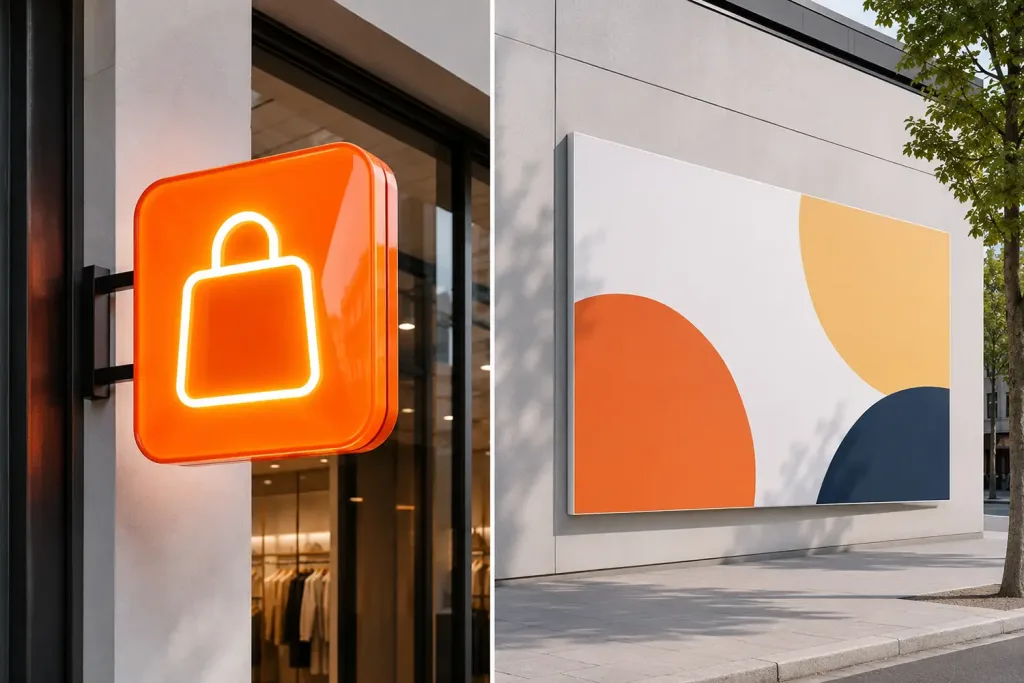
High-end storefront signs, corporate logos, and architectural branding demand visual depth that cheaper materials cannot replicate. Acrylic’s high surface gloss and optical clarity create a glass-like finish that makes colors appear more vibrant and lettering more defined — qualities that are immediately visible to anyone walking past a storefront.
That visual standard, however, has to survive the fabrication process. Sign acrylic sheet formulations deliver 10x the impact resistance of standard acrylic (Izod 15 kJ/m²), reducing the risk of cracking and edge damage during routing and installation. A surface tension of 38–40 dynes/cm and ink adhesion of ≥2.5N/cm ensure printed graphics hold consistently across production batches.
For applications requiring pure transparency, cast clear acrylic (1–50mm) offers 92% light transmittance — comparable to optical glass — with haze below 1% and no optical distortion, delivering a precision finish that reinforces rather than competes with the brand it displays.
Achieving Uniform Illumination in Backlit Signage
For channel letters, light boxes, and illuminated brand logos, light diffusion performance is often as important as light transmission itself. Poor diffusion results in visible LED hotspots and uneven brightness — inconsistencies that are most apparent after dark, precisely when illuminated signage is most visible and brand presentation matters most.
Diffuser-grade acrylic addresses this by embedding light-diffusing particles directly into the PMMA substrate rather than applying surface treatments that can degrade or wear unevenly over time. This structural approach distributes light evenly across the entire sign face while maintaining high transmission efficiency — typically 85–92% transmittance with a hotspot shielding rate of ≥99% in engineered diffuser formulations.
This level of optical control makes LED acrylic panel the go-to choice for illuminated channel letters, logo signs, and slim-profile light boxes where consistent brand appearance across multiple locations — and across years of outdoor service — is a project requirement rather than a preference.
Why PVC Foam Board Is Specified for Cost-Efficient Outdoor Signage
Excellent Printability for Large-Format Signage
For applications where printed graphics are the primary output, PVC foam board offers a practical advantage over many alternative substrates. Its smooth surface finish — typically Ra ≤0.8μm — and ink adhesion of ≥2.5N/cm allow UV flatbed printing to be applied directly without additional priming or surface preparation. This eliminates a production step that adds both time and cost, making PVC foam board particularly efficient for high-volume print runs where turnaround speed matters.
For sign manufacturers producing real estate signs, event graphics, promotional displays, and retail advertising systems at scale, this combination of direct printability and low material cost makes PVC foam board a standard specification — especially where projects require consistent color reproduction across large panel counts without the per-unit cost of premium substrates.
Cost-Effective Fabrication for Dimensional Letters
Dimensional lettering adds visual depth to signage, but traditional production workflows often require priming and painting after routing — steps that increase both labor costs and lead times. PVC foam board simplifies this process: it can be CNC routed cleanly across a range of thicknesses from 3mm to 30mm, producing lightweight letters that are straightforward to transport and install without secondary finishing.
For projects requiring colored dimensional letters, PVC color foam board reduces fabrication steps further by integrating the color layer directly into the board surface during manufacturing. With batch color consistency maintained at ΔE≤2, this eliminates post-painting entirely while delivering predictable color accuracy across high-volume production runs — a meaningful advantage for retail chains, wayfinding systems, and promotional campaigns where visual consistency across multiple locations is a project requirement.
Lightweight Construction and Lower Installation Costs
One of the primary reasons PVC foam board is widely used in outdoor signage is its exceptionally low weight. With a density typically ranging from 0.45–0.65 g/cm³, PVC foam board weighs approximately 1.5 kg/m² at 3mm thickness — compared to around 3.6 kg/m² for acrylic sheet of equivalent thickness. This weight difference becomes increasingly significant at scale, particularly for large-format signage projects where material handling, transportation, and installation labor represent a meaningful share of total project cost.
The lightweight structure simplifies every stage of the production and installation workflow. Panels can be moved and positioned without lifting equipment, mounting systems require less structural reinforcement, and installation teams can work faster with less physical effort. For temporary campaigns, real estate signage, promotional boards, and directional signage — where projects often involve high panel counts across multiple locations — these efficiencies compound quickly into measurable budget savings.
How Acrylic and PVC Foam Board Compare in Real-World Outdoor Applications
Fabrication, Structural Performance, and Service Life Comparison
Performance Factor
Acrylic Sheet
PVC Foam Board
Laser Cutting
Suitable; produces clean flame-polished edges with no secondary finishing required
Suitable; recommended power 50–100W
CNC Routing
Excellent; 120-tooth alloy blade recommended
Excellent; spindle tools or 100–120 tooth circular saw recommended
Density
1.19 g/cm³
0.45–0.65 g/cm³
Weight at 3mm
~3.6 kg/m²
~1.5–1.8 kg/m²
Flexural strength
90–110 MPa (cast acrylic); high rigidity, suitable for large unsupported panels
22–30 MPa (varies by density); larger panels may bow under sustained wind load
Structural Support
Robust mounting frames recommended for large installations
Frame support recommended for larger panels; consult structural requirements based on panel size and local wind load conditions
Outdoor Lifespan
5–10+ years; ≥85% light transmittance retention and ΔE<3 after 5,000 hours UV testing
Promotional displays, real estate signs, temporary and budget-conscious signage
Fabrication Safety Note: When laser cutting PVC foam board, ensure adequate ventilation and wear appropriate respiratory protection during processing. Recommended cutting power is 50–100W. CNC routing and circular saws are equally viable alternatives.
Structural Note: Acrylic’s higher flexural strength (90–110 MPa vs. 22–30 MPa for PVC foam board) makes it the more reliable choice for large unsupported panels in wind-exposed environments. For PVC foam board installations, frame support requirements should be assessed based on panel size, thickness, and local wind load conditions.
What These Differences Mean in Practice
Neither material is universally better. The choice depends on the priorities of the project.
Acrylic offers greater rigidity, superior weather resistance, and compatibility with laser fabrication, making it a preferred option for permanent signage installations where appearance and longevity are critical.
PVC foam board prioritizes weight reduction and cost efficiency. For large panels or wind-exposed installations, additional structural support may be required. It remains an effective solution for printed graphics, promotional signage, and medium-term outdoor projects.
Can Acrylic and PVC Foam Board Be Used Together?
In many commercial signage projects, the best solution is not choosing between acrylic and PVC foam board, but combining both materials within the same sign system to take advantage of what each does best.
A common example is illuminated channel lettering. The front face is typically manufactured from acrylic — providing light transmission, UV stability, and a premium finish — while the backing structure and mounting components are produced from PVC foam board, where optical clarity is unnecessary but lightweight construction offers practical advantages in installation and cost.
The same principle applies across retail branding systems, directory signs, and exhibition displays: acrylic for visible surfaces and illuminated elements, PVC foam board for structural or backing components where appearance is secondary to weight and cost efficiency.
For large commercial signage programs, this hybrid approach often delivers better overall value than specifying a single material throughout — optimizing appearance, durability, and project cost simultaneously.
Procurement Checklist: Acrylic Sheet or PVC Foam Board?
Choose Acrylic Sheet If:
✓ Backlit or illuminated signage (light transmittance ≥85%)
✓ Premium storefront or corporate branding
✓ Long-term outdoor installation (5–10+ years)
✓ Laser cutting or precision edge finishing required
✓ Optical uniformity and hotspot control critical
Choose PVC Foam Board If:
✓ Large-format UV printing without surface preparation
✓ Temporary or medium-term signage (2–5 years)
✓ Budget-sensitive or high-volume projects
✓ Lightweight installation on low-load structures
✓ CNC-routed dimensional letters without post-painting
Frequently Asked Questions
Q1: Is acrylic or PVC better for outdoor signs?
A: It depends on what the sign needs to do. Acrylic is the better choice for permanent installations like storefront branding, illuminated channel letters, and corporate identity systems where appearance needs to hold up for years. PVC foam board makes more sense when the priority is fast production, lower cost, and a lifespan measured in months or a few years rather than a decade.
Q2: How long does PVC foam board last outdoors?
A: Typically 2–5 years, though actual performance varies with UV exposure, climate, and how the sign is installed. If the project needs to look good for five years or more without maintenance, acrylic is the safer specification.
Q3: What material is used for LED light box signs?
A: LED Light Acrylic Sheet. Unlike regular acrylic, it contains light-diffusing particles embedded in the substrate that distribute illumination evenly across the sign face, achieving 85–92% light transmittance with a hotspot shielding rate of ≥99%. The result is clean, uniform backlighting with no visible LED points.
Q4: Can PVC foam board be used for illuminated signage?
A: No. PVC foam board is an opaque substrate and does not transmit light. For any application requiring backlighting or LED illumination, acrylic sheet is required.
Q5: What is the difference between acrylic and PVC foam board in terms of weight?
A: At 3mm thickness, acrylic sheet weighs approximately 3.6 kg/m² compared to 1.5–1.8 kg/m² for PVC foam board. This weight difference becomes significant in large-format projects where transportation, handling, and installation costs are important considerations.
Conclusion
The choice between acrylic sheet and PVC foam board is rarely about determining which material is universally better. Instead, it depends on project priorities.
Acrylic remains the preferred option when long-term durability, premium appearance, and illuminated signage performance are critical. PVC foam board excels when lightweight construction, printability, and cost efficiency are the primary considerations.
In many commercial signage projects, the most effective solution is not choosing one material over the other, but combining both materials to balance performance, appearance, and budget.
Introduction In the ever-evolving world of materials science, acrylic sheets have long been celebrated for their versatility and durability. However, as design requirements become more...
Brief introduction Acrylic board is widely used in all walks of life because of its excellent transparency, light weight and machinability. However, they differ significantly...
If you work in UV curing, medical diagnostics, optical research or tanning equipment design, you’ve probably asked: What material can reliably transmit UV light without...
When making engraved name badges, office signs or equipment labels, the biggest question is:Which material gives crisp, professional contrast without extra painting? Dual-color sheet is...