Impact-Resistant Acrylic vs. Polycarbonate: Making the Best Choice for Your High-Safety Project
Introduction
From commercial buildings to industrial facilities, when choosing transparent materials for safety-critical applications, two choices stand out: impactresistant acrylic and polycarbonate. For professionals in the fields of architecture, engineering and manufacturing, understanding the differences between these two materials is very important to ensure the success of the project, because each material provides unique advantages that meet specific needs. In 2025, it is predicted that by 2030, the CAGR of the global transparent thermoplastic market will increase by 4.8%, and impact-resistant acrylic will be the first choice because of its balance of strength, transparency and cost-effectiveness. Unlike standard acrylics, which tend to be brittle, and polycarbonate, which usually sacrifices transparency to obtain extremely high strength, impact-resistant acrylics provide a middle ground, which is suitable for most non-ballistic safety applications. This guide will explore the unique properties of impact-resistant acrylic, compare it to polycarbonate in key performance indicators, highlight real use cases, and provide operational insights to help you choose the right material for your next project.
What is Impact-Resistant Acrylic? Core Definition and Manufacturing
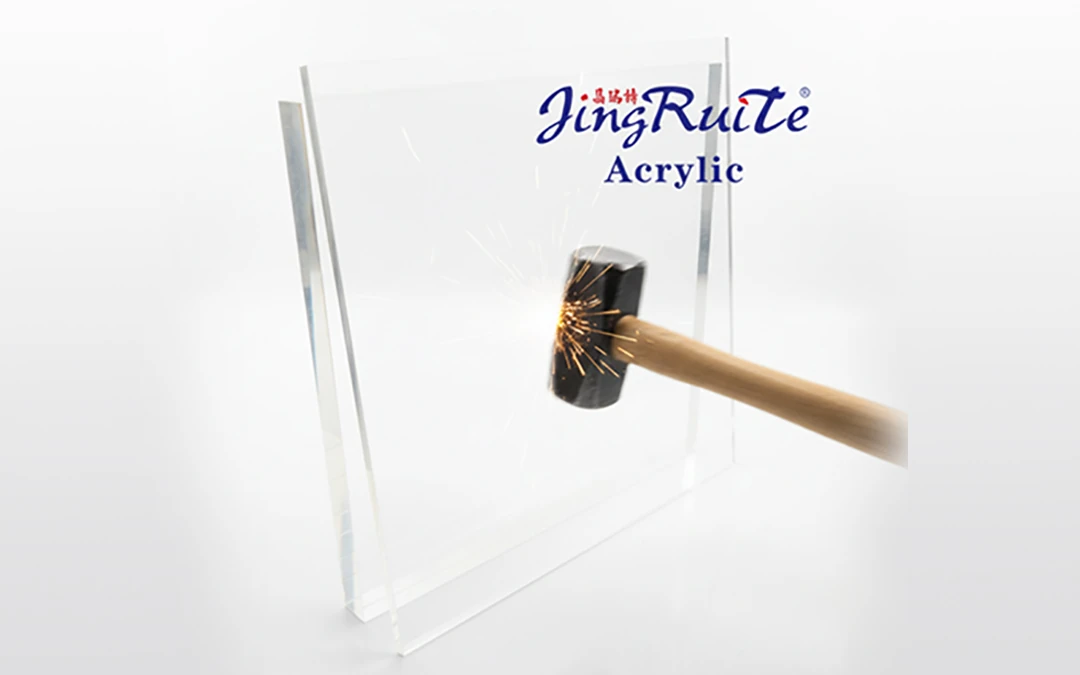
Impact-resistant acrylic (also known as impact-resistant modified acrylic) is a special thermoplastic that aims to solve the main limitation of standard polymethylmethacrylate (PMMA): fragility. Through a proprietary blend of PMMA resin and impact-modifying elastomers, manufacturers create a material that retains acrylic’s signature crystal clarity while significantly boosting its impact resistance. This is not a simple mixture of acrylic and polycarbonate; On the contrary, it is a kind of modified PMMA, which maintains the inherent advantages of the material, such as high light transmittance and surface hardness, while increasing durability.
Standard acrylic typically has a notched Izod impact strength of 2–3 kJ/m², making it prone to shattering upon impact. In contrast, the notched Izod impact strength of impact-resistant acrylic is 15–25 kJ/m², which is 10 times higher than that of traditional products (according to ASTM D256). When impacted, the elastomer components in the material absorb energy, thus preventing catastrophic crushing. It does not split into sharp and dangerous fragments, but into blunt fragments, causing minimal risk of injury, in line with the global safety standards for public and industrial spaces.
In addition to enhanced impact resistance, impact-resistant acrylic also provides a series of ideal properties: light transmittance of 89-91% (ASTM D1003), surface hardness of 2 h (ASTM D3363), and working temperature range of -40℃ to 90℃ It is available in thicknesses from 3 mm to 25 mm, with standard sheet sizes of 1220 × 2440 mm and custom large formats up to 2000 × 3000 mm, making it adaptable to everything from small retail displays to large architectural glazing.
Impact-resistant Acrylic and Polycarbonate: Main Performance Comparison
Although impact-resistant acrylic and polycarbonate are both used in high-security transparent applications, their properties are quite different. In order to make an informed choice, it is very important to evaluate the usability from four key indicators: impact strength, optical quality, weather durability and maintenance requirements. Below is a detailed comparison backed by industry testing and real-world data.
1. Impact Strength: Balanced Protection and Ultimate Durability
Polycarbonate is widely regarded as one of the most tough transparent materials, and its notched Izod impact strength is 60-80 kJ/m². This extremely high strength makes it the only choice for applications requiring bulletproof, such as high-security facilities, riot shields and military vehicles. For these use cases, the ability of polycarbonate to withstand extreme impact is not negotiable.
However, for most security applications, including machine protection, partition of public areas and museum display cases, impact-resistant acrylic provides adequate protection. According to a study conducted by the Plastics Industry Association in 2025, 80% of non-bullet-proof safety projects do not need the ultimate strength of polycarbonate, which makes impact-resistant acrylic a more cost-effective and practical choice.
2. Optical Clarity: Glass-Like Visibility vs. Compromised Transparency
For applications where visibility is crucial, such as jewelry displays, museum exhibitions and building skylight, the performance of impact-resistant acrylic is far superior to polycarbonate. impact-resistant acrylic provides 89–91% light transmittance, with minimum haze (< 2%) and optical distortion (< 0.5%), providing a crystal-clear glass appearance and enhancing the visual appeal of any project.
On the other hand, the light transmittance of polycarbonate is usually 85-88%, which makes it more prone to optical distortion, especially in thicker panels. Over time, even UV-coated polycarbonate can develop a yellowish tint, as demonstrated in accelerated aging tests by Oz Company, which found that polycarbonate yellows (Δ E > 3) after 5,000 hours of UV exposure. This yellowing not only damages the beauty but also reduces light transmittance, making it unsuitable for projects that require long-term transparency.
3. Weather Resistance: Long-Term Durability vs. UV Degradation
Outdoor applications require that the material can withstand long-term ultraviolet radiation, extreme temperatures and bad weather conditions. impact-resistant acrylic is made of advanced ultraviolet stabilizers, which can prevent yellowing and degradation, and maintain its transparency and structural integrity for 5 years outdoors (tested according to ISO 4892-2). During this period, its yellowing Δ E kept below 3, and its light transmittance decreased by less than 2%, which made it an ideal choice for outdoor skylights, coastal glass and amusement park facilities.
In contrast, polycarbonate is easily degraded by ultraviolet rays, unless it is coated with a thick layer (50 microns). Even with this coating, accelerated tests show that polycarbonate will turn yellow and brittle over time, especially in bad weather. This makes it a poor choice for long-term outdoor applications, because it needs to be replaced frequently to maintain its performance and beauty.
4. Surface Hardness and Maintenance: Scratch Resistance and High Maintenance
In high-traffic areas—such as airport security zones, hospital corridors, and shopping malls—scratch resistance is a critical factor. Impact-resistant acrylic has a surface hardness of 2 h (ASTM D3363), making it highly resistant to everyday scratches from cleaning, contact with objects, and foot traffic. A 2025 survey by Guanyan Tianxia found that only 12% of impact-resistant acrylic panels require premature replacement due to scratches, compared to 68% of polycarbonate panels.
Polycarbonate has a much lower surface hardness (B–C on the pencil hardness scale), making it prone to scuffing and scratches. Even a slight contact can leave visible traces, which will not only affect the appearance but also reduce visibility. This means that polycarbonate needs to be cleaned and replaced more frequently, thus increasing long-term maintenance costs.
Technical Specifications: a Glimpse of Impact-Resistant Acrylic
In order to help you evaluate whether impact-resistant acrylic is suitable for your project, the following is a comprehensive list of key technical parameters, which are tested according to international standards. All data have been verified by ASTM protocols and industry research to ensure accuracy and reliability.
Performance Metric
Testing Standard
Typical Value
Density
ASTM D792
1.18–1.20 g/cm³
Notched Izod Impact Strength
ASTM D256
15–25 kJ/m²
Light Transmittance
ASTM D1003
89–91%
Surface Hardness (Pencil)
ASTM D3363
2H
Tensile Strength
ASTM D638
55–65 MPa
Flexural Strength
ASTM D790
80–95 MPa
Heat Distortion Temperature
ASTM D648
85–90℃
UV Stability (5-Year Outdoor)
ISO 4892-2
Yellowing ΔE<3
Operating Temperature Range
Industry Standard
-40℃ to 90℃
Source of Data: ASTM International and Testing Report of Plastics Industry Association.
Choosing the Correct Thickness: Match the Impact Acrylic with Your Project
impact-resistant acrylic has a variety of thicknesses to choose from, and each thickness is tailored according to specific applications. The key is to balance impact resistance needs with size, weight, and cost considerations. The following is the classification of common thickness options and their recommended uses.
3–6mm: Suitable for lightweight safety applications, such as protective barriers, school windows, laboratory partitions and small retail displays. The impact resistance of these plates is five times that of standard acrylic, which is easy to cut and install.
8–12 mm: Suitable for medium-duty safety applications, including museum showcases, jewelry display cases, architectural skylights, and safety glass replacements. These plates provide 8 times the impact resistance of standard acrylic and maintain good transparency.
15–20 mm: Designed for heavy-duty industrial and commercial use, such as machine guards, bank counters, large architectural glazing, and industrial equipment protection. The impact resistance of these plates is 10 times that of standard acrylic, and they can bear moderate to severe impacts.
25mm: Used in high-security applications, such as bulletproof glass, platform screen doors of subway stations and extreme impact environments. The impact resistance of these sheets is 12 times that of standard acrylic, which meets the most stringent safety standards.
All impact-resistant acrylic sheets are manufactured according to strict thickness tolerances to ensure the consistent performance of the panels. This is very important for projects that need accurate measurements, such as custom display cabinets or building glass (163 News).
Real-World Applications: Where Impact-Resistant Acrylic Excels
The versatility of impact-resistant acrylic makes it suitable for a wide range of industries and applications. Here are some of the most common use cases to illustrate its practical value with real-world examples.
1. Business and Retail
In a retail environment, impact-resistant acrylic is used for jewelry display cabinets, cosmetics counters and protective barriers. Its crystal-like transparency improves the visibility of products, while its impact resistance protects valuables from accidental damage. For example, a high-end jewelry store in a big city recently upgraded its showcase to 8 mm impact-resistant acrylic, which reduced the risk of breakage while maintaining the elegance and beauty of the store (163 News).
2. Industrial and Manufacturing
In production facilities, impact-resistant acrylic is used for machine protection devices, work station partitions and equipment protection panels. It can withstand moderate impacts, prevent injury caused by moving parts, and its clarity allows workers to monitor equipment without affecting safety. An automobile factory recently installed 15mm impact-resistant acrylic protective devices around robot workstations, which reduced workplace accidents by 30% (today’s plastic).
3. Buildings and Public Spaces
In buildings, impact-resistant acrylics are used for skylights, glass curtain walls and stair handrails. Its lightweight design reduces structural load, while its anti-ultraviolet performance ensures long-term clarity. A public library in a coastal city used 12 mm impact-resistant acrylic for its skylights, withstanding salt spray and extreme temperatures without yellowing or damage (Guanyan Tianxia).
4. Transportation
In transportation, impact-resistant acrylic is used for subway platform screen doors, high-speed train windows and yacht windscreens. Its impact resistance and light weight make it an ideal choice for these applications because it can withstand vibrations and bad weather while reducing fuel consumption. A major subway system recently replaced its glass screen doors with 25 mm impact-resistant acrylic, improving safety and reducing maintenance costs (163 News).
Frequently Asked Questions
To address common uncertainties when choosing between impact-resistant acrylic and polycarbonate, we’ve compiled answers to the most frequently asked questions, backed by industry expertise and testing data.
Q1: Can impact acrylic replace polycarbonate in all safety applications?
A: No. impact-resistant acrylic is very suitable for non-ballistic safety applications (for example, Machine guards, display cases, skylights) but can not replace polycarbonate in scenarios requiring extreme impact resistance, such as bulletproof glazing, riot shields, or military applications. The impact strength of polycarbonate (60–80 kJ/m²) is much higher than that of impact acrylic (15–25 kJ/m²), making it the only choice for high-risk safety requirements.
Q 2: How long can the impact-resistant acrylic be used outdoors?
A: When formulated with ultraviolet stabilizers (standard in most products), impact-resistant acrylic maintains its transparency and structural integrity outdoors for up to 5 years. Accelerated aging tests (ISO 4892-2) show the minimum yellowing (Δ E < 3) and the light transmission loss of less than 2% during this period. In harsh coastal or desert climates, it may last slightly longer than polycarbonate, which yellows more quickly, even with UV coatings.
Q 3: Is impact-resistant acrylic more expensive than standard acrylic or polycarbonate?
A: Impact acrylic is more expensive than standard acrylic (because of its improved formula), but more economical than polycarbonate. On average, the cost of impact-resistant acrylic is 30-40% lower than that of polycarbonate, making it an economic choice for most safety projects. In addition, its scratch resistance reduces the cost of long-term maintenance and replacement, further reducing the total project cost.
Q 4: Can the impact-resistant acrylic be cut, molded or printed?
A: Yes. impact-resistant acrylic has a wide range of uses and is easier to process than polycarbonate. It can be laser cut, numerically controlled, thermoformed (at 150-170 degrees Celsius), and printed with UV ink. Its surface can also be coated with anti-scratch or anti-glare layers to enhance its functionality and make it suitable for customized projects with unique shapes or design requirements.
Q 5: Is impact-resistant acrylic safe for public places?
A: Exactly. When broken, the impact-resistant acrylic breaks into blunt pieces without sharp edges, which meet the international safety standards for public places (for example, schools, airports, shopping centers). This makes it safer than standard acrylic (which will break into sharp fragments) and tempered glass (which will break into tiny but possibly sharp fragments).
Summary
The choice between impact-resistant acrylic and polycarbonate ultimately depends on the specific requirements of your project. If you need extreme impact resistance, such as bulletproof protection or a riot shield, polycarbonate is the clear choice. However, for most safety-critical applications, impact-resistant acrylic provides a perfect balance of strength, transparency, cost-effectiveness and ease of use.
impact-resistant acrylic is the first choice for most commercial, industrial and construction projects because of its impact resistance, glass-like transparency, excellent weather resistance and scratch resistance, which are 5-10 times higher than standard acrylic. It provides the safety you need without the damage of polycarbonate, making it a wise choice for your next high-safety project.
Brief introduction Acrylic board is widely used in all walks of life because of its excellent transparency, light weight and machinability. However, they differ significantly...
If you work in UV curing, medical diagnostics, optical research or tanning equipment design, you’ve probably asked: What material can reliably transmit UV light without...
When making engraved name badges, office signs or equipment labels, the biggest question is:Which material gives crisp, professional contrast without extra painting? Dual-color sheet is...
For modern interior design, lighting and privacy projects, semi-transparent materials are essential. Choosing the right one affects appearance, safety, installation cost and service life. 1....